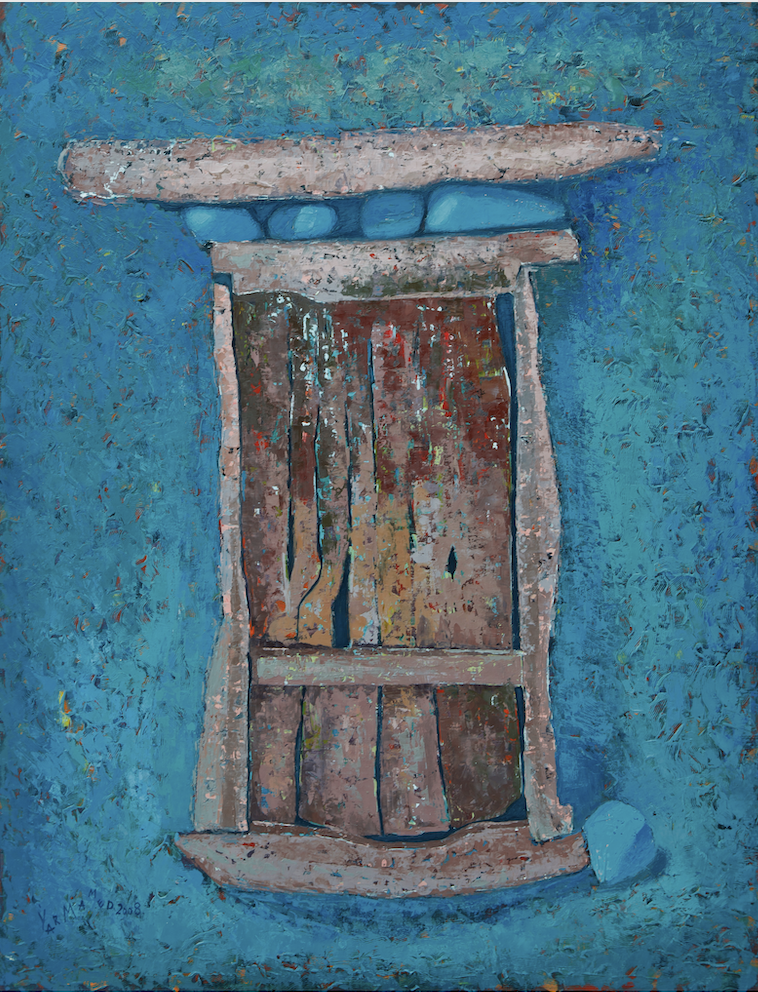
“Composition No. 7” from the “Nokhur” series, 2008
Oil on canvas. 90 × 115 cm
In this work, the architectural motif is transformed from a specific element of the rural environment into an independent artistic image. In the center of the composition is a massive wooden door, enclosed in a light stone frame and surrounded by an intense turquoise blue space. The artist almost completely abandons narrative: there are no people, everyday scenes or detailed landscapes. All attention is focused on one object – the entrance, the border between external and internal space.
At first glance, the composition is extremely simple. However, it is precisely this frontality that gives the image a special monumentality. The door occupies almost the entire vertical axis of the canvas and is perceived simultaneously as a real architectural fragment and as a sign. Its design is deliberately devoid of geometric correctness: the verticals are slightly offset, the frame is asymmetrical, and the stone elements look heavy and almost primitive. Thanks to this, architecture seems not to be built according to a blueprint, but to have developed gradually – under the influence of time, material, human labor and the environment itself.
Color plays a special role. The rich turquoise blue surface of the background does not function as a traditional image of a wall or sky. It becomes an independent picturesque environment, within which an architectural form exists. Numerous brushstrokes, splashes of color and palette knife marks break up the monotony of the blue field. Upon closer inspection, it reveals ocher, reddish, green and dark accents. Due to this, the color acquires depth and internal movement.
Against the backdrop of a cold blue space, the door sounds especially expressive – complex in color, built on a combination of earthy brown, ocher, gray-pink and muted red shades. The artist does not seek to literally reproduce the texture of old wood. The surface of the door is created through a multi-layer application of paint material, scratches, vertical drips and fragmentary color spots. The depicted object and the painting surface itself begin to exist almost on equal terms: traces of time on the old door echo the traces of the work of a brush and palette knife on the canvas.
The upper part of the architectural structure is especially important to the overall character of the work. A heavy horizontal stone beam and a series of rounded blue elements create an almost archaic structure, reminiscent of traditional architecture, ancient masonry and conventional ornamental rhythm. The artist deliberately enhances the physical heaviness of the upper part, contrasting it with the vertical movement of the door boards. Thanks to this, a tense balance of horizontals and verticals arises.
The door in the work can be viewed more broadly – as a universal cultural symbol. It denotes a transition, a boundary, the possibility of entry and at the same time the inability to see what is beyond it. A closed door creates a state of uncertainty: the viewer is shown a threshold, but the interior space remains inaccessible. This is what turns an everyday architectural motif into an image of memory, solitude and preserved inner peace.
The connection of the work with Nokhur is manifested not so much through a documentary depiction of a specific place, but through an artistic understanding of its material culture. An architectural detail becomes a carrier of memory of the traditional way of life, craft and the way of human interaction with natural materials. The artist is not interested in ethnographic accuracy, but in the visual essence of the environment – rough stone, wood, rich color, simplicity of design and the feeling of the long existence of things.
An important feature of the canvas is the lack of traditional perspective. The space is practically reduced to a plane. The architectural object is located almost parallel to the surface of the canvas, and the blue mass surrounding it does not create the usual illusion of depth. This technique brings the composition closer to a sign or icon: a specific object is freed from random details and acquires a more generalized meaning.
At the same time, the work does not become decorative in the narrow sense. Behind the brightness of the color scheme, the materiality of the surface is felt. The dense, sometimes almost relief-like layer of paint makes the painting physically tangible. Color here not only describes the subject, but also shapes it. The stone appears heavy thanks to thick gray-pink layers, the wood appears old thanks to a complex combination of brown, ocher and red, and the blue space gets its own texture thanks to hundreds of directional brushstrokes.
From an artistic point of view, “Composition No. 7” is based on several expressive oppositions: cold and warm, plane and volume, stable architectural structure and free pictorial surface, real object and symbol. Thanks to this, a rather laconic plot acquires internal complexity.
T