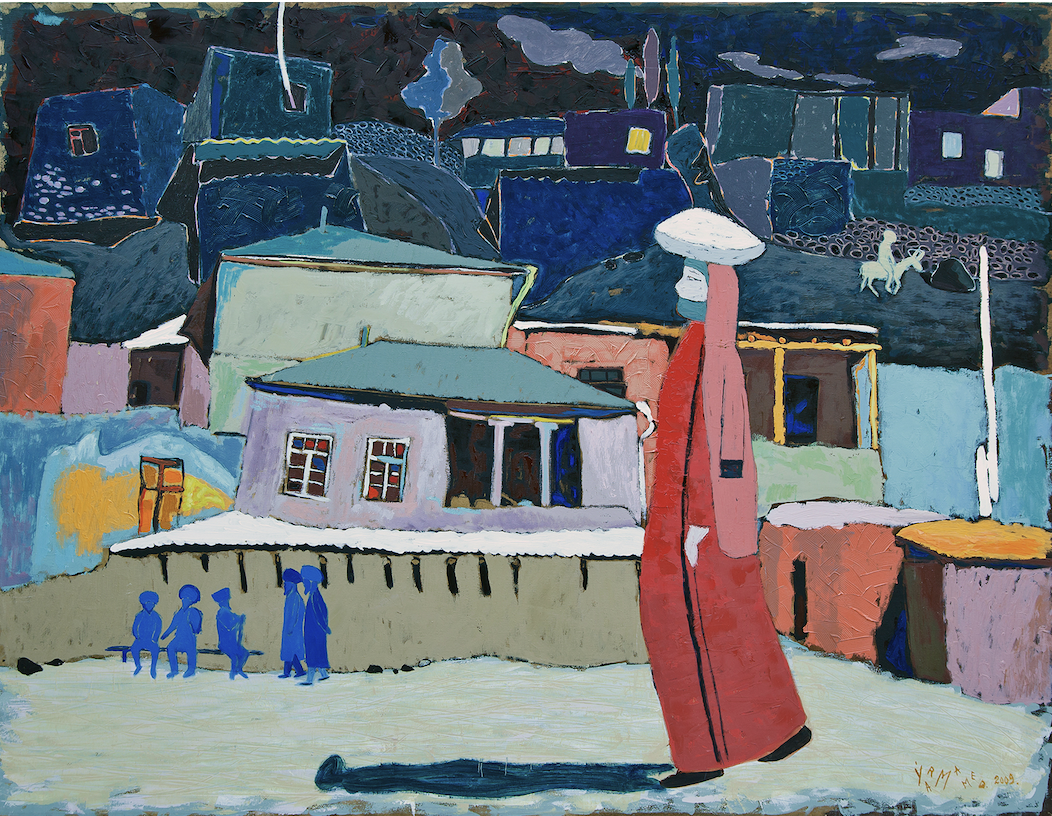
“Composition No. 10” from the “Nokhur” Series, 2009
Oil on canvas, 100 × 130 cm
In “Composition No. 10,” the artist transforms a scene of everyday life in Nokhur into a highly structured, almost theatrical composition. The painting combines architecture, landscape, and human presence, yet none of these elements is treated naturalistically. Instead, the village is reconstructed through flattened space, saturated colour, simplified forms, and a deliberate hierarchy of scale.
The central figure immediately dominates the composition. Dressed in a long red garment and carrying a large white bundle or load above the head, the figure is markedly larger than the people and buildings around it. This distortion of scale is clearly intentional. Rather than obeying conventional perspective, the artist gives visual prominence to the human figure and turns it into the principal symbolic and compositional axis of the work.
The figure is positioned slightly to the right of centre, allowing the surrounding village to remain visible and active. Its elongated vertical form contrasts sharply with the predominantly horizontal rhythm of the architecture. The long red silhouette rises through the middle of the painting, cutting across the layered settlement behind it. This produces a strong tension between the verticality of the person and the horizontal accumulation of roofs, walls, terraces, and pathways.
Colour plays a decisive role. The intense red of the central figure creates the strongest chromatic accent in the painting. Around it, the artist builds a complex environment from deep blues, turquoise, violet, pale green, dusty pink, grey, black, and ochre. These colours are not used to reproduce the visible world literally. They organize the composition and give each architectural fragment its own visual identity.
The village itself is represented as a dense accumulation of geometric forms. Houses seem stacked one above another, rising toward the upper edge of the canvas. Perspective is compressed, and the distinction between foreground, middle ground, and background becomes intentionally unstable. This gives the settlement the appearance of a continuous constructed surface rather than a conventionally receding landscape.
Such spatial compression is particularly effective in conveying the character of a mountain village. Architecture appears to grow organically from the terrain, with houses, walls, roofs, and pathways interlocking into a single visual structure. The painting therefore communicates not only the appearance of the settlement but also its density, compactness, and relationship with the landscape.
The upper part of the composition is noticeably darker. Deep blue and near-black masses create a dramatic background against which the coloured buildings become more pronounced. Small light patches within this dark zone may be read as fragments of sky or cloud, but they also function as abstract tonal accents. The effect is less meteorological than pictorial: the dark upper register gives weight to the composition and heightens the luminosity of the lower village.
The lower area, by contrast, is lighter and more open. A broad pale surface stretches across the foreground, creating visual space around the central figure. The long dark shadow extending from the figure is especially significant. It strengthens the sense of physical presence while also introducing a second horizontal element that counterbalances the figure’s verticality.
The smaller human figures on the left operate on a different scale and rhythm. Their simplified blue silhouettes are almost schematic, yet they animate the scene and establish a social dimension. They suggest conversation, gathering, and everyday communal life. Their reduced size also reinforces the dominance of the central figure.
The painting therefore does not present a single narrative episode in a literal sense. It is more accurate to understand it as a constructed image of social space. The village becomes a stage on which architecture and human presence are inseparable. The buildings are not merely background scenery; they form the cultural and material environment that defines the figures within it.
Stylistically, the work balances figuration and abstraction. The subject remains clearly recognizable, but forms are simplified and sometimes reduced to planes, silhouettes, and blocks of colour. Windows, doors, roofs, and walls are represented through strongly defined geometric shapes, while individual details are subordinate to the overall rhythm of the composition.
The treatment of architecture is especially important. The artist avoids descriptive precision in favour of structural clarity. Each building becomes part of a larger visual system of rectangles, diagonals, and horizontal bands. This produces a near-mosaic effect, where the entire settlement is assembled from colour fields and simplified architectural units.
The central figure introduces a different type of form: organic, elongated, and fluid. This contrast between the rigid geometry of the village and the softer vertical line of the human body gives the painting much of its visual energy. The person does not merely inhabit the architecture but interrupts and reorganizes it.
Within the context of the “Nokhur” series, “Composition No. 10” can be understood as a study of the relationship between people, settlement, and cultural environment. The artist does not attempt to produce an ethnographic record. Instead, he extracts the essential visual characteristics of place—compressed architecture, strong colour contrasts, human movement, and the interaction between built space and daily life.
The monumental treatment of the central figure adds a symbolic dimension. The figure can be read as an embodiment of labour, endurance, and continuity within the community. The scale difference suggests significance rather than literal spatial distance. In this sense, the work moves beyond genre painting and toward a broader reflection on human presence within a traditional environment.
The painting’s emotional force comes from this combination of the ordinary and the monumental. A familiar village scene becomes a carefully balanced image of place, memory, and social life. The artist transforms everyday observation into a visual language in which colour, scale, and structure carry as much meaning as the subject itself.
For a gallery website, I would recommend this shorter version:
“Composition No. 10” from the “Nokhur” series presents village life through a deliberately flattened and highly expressive pictorial language. At the centre of the work stands an elongated figure in red, carrying a large white bundle, whose exaggerated scale immediately establishes the visual and symbolic focus of the painting.
The figure rises against a densely layered settlement built from deep blues, turquoise, violet, pink, green, and ochre. Houses appear stacked across the surface rather than receding according to conventional perspective, giving the village a compressed, almost mosaic-like structure.
The contrast between the strong vertical presence of the figure and the horizontal rhythm of roofs, walls, and terraces creates the principal tension of the composition. Smaller blue figures in the foreground introduce a sense of everyday communal life, while the long shadow of the central figure anchors the image spatially and rhythmically.
Rather than documenting Nokhur literally, the artist reconstructs the village through colour, geometry, and memory. Architecture, landscape, and human presence merge into a single visual system. The central figure, monumental in scale yet rooted in an everyday scene, may be understood as an image of labour, resilience, and continuity.
The work stands between genre painting, landscape, and decorative abstraction, transforming a local scene into a broader meditation on community, place, and the enduring relationship between people and their environment.