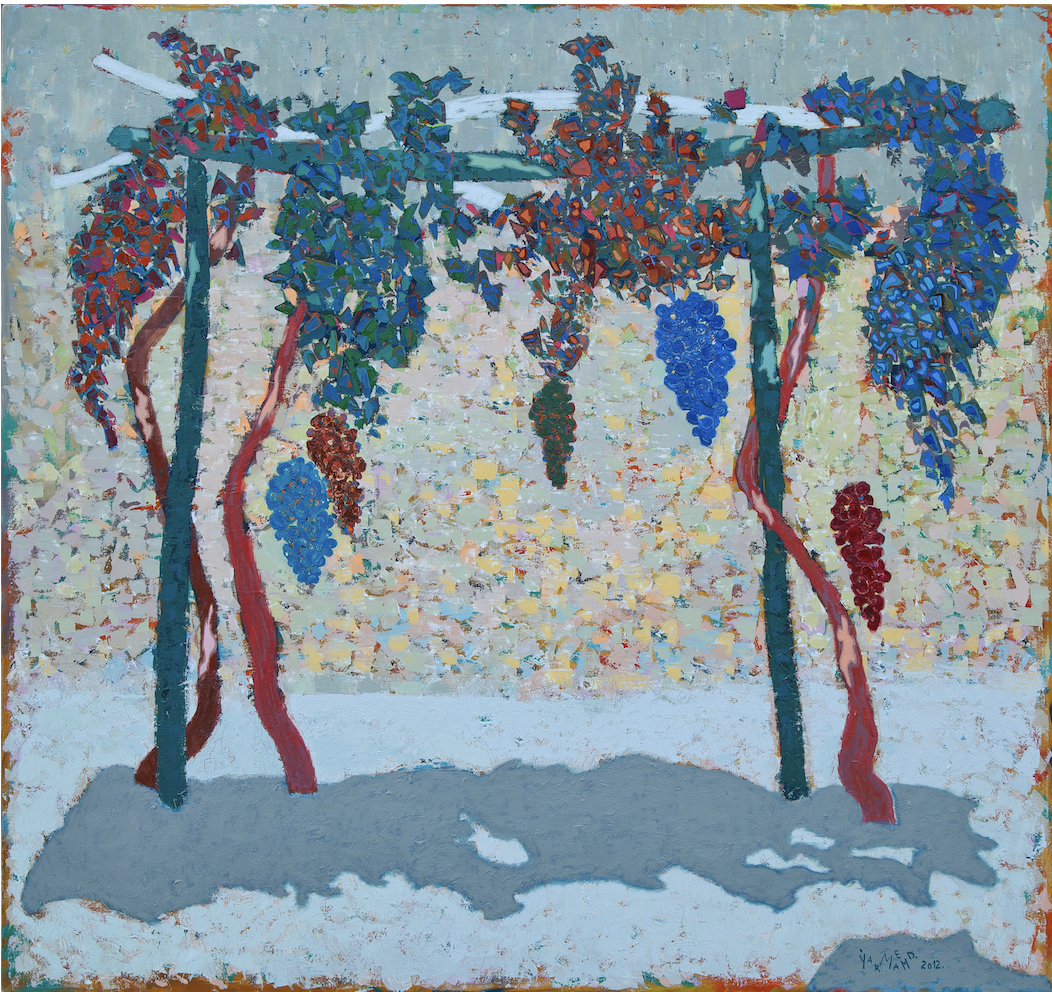
“Composition No. 21” from the “Nokhur” Series, 2012
Oil on canvas, 115 × 110 cm
In “Composition No. 21,” the artist turns to one of the most recognizable motifs of traditional rural life—the grapevine. Yet this is not a naturalistic depiction of a vineyard or garden. The familiar subject is transformed into an almost monumental decorative composition in which colour, rhythm, and texture become more important than literal representation.
The composition is deliberately clear and balanced. Two vertical supports frame the scene, while vines, branches, and hanging clusters of grapes unfold between them. The horizontal structure above binds the composition together and evokes a traditional grape arbour. The result is not so much an open landscape as an intimate, cultivated environment shaped by both nature and human labour.
A central tension in the work lies between structural order and organic freedom. The vertical posts and horizontal beams establish a stable architectural rhythm, while the twisting trunks of the vines disrupt this order with free, almost calligraphic movement. Their irregular lines introduce a sense of growth and vitality. The contrast between the man-made structure and the living plant becomes one of the painting’s principal visual ideas.
The grape clusters are not rendered with botanical precision. Instead, they function as independent masses of colour. Deep blues, turquoise, burgundy, red, green, and orange are distributed across the canvas in a carefully orchestrated rhythm. A luminous blue cluster near the centre acts as one of the principal visual focal points, echoed by cooler blue forms on the left and balanced by red and burgundy accents on the right.
Colour is deliberately liberated from strict naturalism. Blue and turquoise grapes, reddish vines, and cool green-blue supports create an autonomous pictorial reality. Rather than simply describing the natural world, colour generates the emotional atmosphere and internal rhythm of the painting.
The background is far more complex than it initially appears. Its pale surface is constructed from numerous subtle shades—white, cream, yellow, blue, pink, grey, and green. Small strokes and fragments of pigment create a vibrating field of light. This prevents the background from becoming passive and intensifies the saturated forms of the vines and fruit.
Texture is equally important. Visible brushwork and palette-knife marks remain active across the surface. In the foliage and upper grape clusters especially, small fragments of red, blue, green, and turquoise are assembled almost like pieces of a mosaic. This gives the work a pronounced decorative quality while preserving the physical presence of paint itself.
The broad grey-blue form across the lower part of the canvas appears as the shadow cast by the arbour. It anchors the composition and contrasts with the densely articulated upper zone. While the upper section is animated by colour, movement, and detail, the lower area is quieter and more generalized. This visual contrast gives the work stability.
The pictorial space is intentionally flattened. Traditional linear perspective is largely absent; the supports, vines, and grape clusters are arranged close to the surface of the canvas. As a result, the composition approaches the visual logic of a decorative panel, mural, or textile pattern.
This flattening also allows the work to resonate with broader Central Asian visual traditions, in which rhythm, ornament, repetition, and the organization of the coloured surface often carry as much significance as spatial illusion. Yet the artist does not imitate traditional ornament directly. Rather, ornamentality emerges naturally from the repeated structure of the vines, leaves, and fruit.
Within the “Nokhur” series, the grapevine carries significance beyond its botanical identity. It belongs to the lived environment of the region—to cultivation, seasonal labour, household life, and continuity of local practice. Although no human figure is visible, human presence remains implicit throughout the painting. The supports have been constructed, the vines cultivated and guided, and the fruit carefully grown.
The absence of people is therefore important. Human life is represented indirectly through a shaped and cultivated environment. This corresponds to a broader characteristic of the “Nokhur” series: the identity of a place is conveyed not necessarily through portraiture or narrative, but through architecture, plants, objects, and traces of human activity.
The grapevine also allows for a broader symbolic interpretation. Across cultures, it has long been associated with fertility, abundance, continuity, and cyclical renewal. Here, however, symbolism is not imposed through narrative. It emerges from the abundance of fruit itself and from the visual vitality of the entire composition.
From an art-historical perspective, one of the strongest aspects of “Composition No. 21” is its balance between figuration and decorative abstraction. The vineyard remains immediately recognizable, yet closer observation gradually transforms it into a system of lines, coloured masses, textures, and rhythmic repetitions.
The artist is therefore not simply representing a particular grape arbour. He is distilling its visual essence: the upward movement of the vines, the weight of the hanging fruit, the interplay of shade and light, and the distinctive colouristic intensity of a cultivated southern landscape.
For a gallery website, I would recommend the following more concise version:
“Composition No. 21” from the “Nokhur” series transforms the familiar image of a grape arbour into a carefully structured interplay of colour, rhythm, and texture. The strict verticals of the supporting posts contrast with the freely twisting vines, while clusters of grapes become vivid chromatic accents across the surface.
Rich blues, turquoise, burgundy, red, and green are deliberately removed from strict naturalism. Colour functions not merely as description, but as an independent expressive force. The foliage and fruit are built from numerous small strokes and fragments of paint, giving the surface an almost mosaic-like character.
The pale, vibrating background intensifies the saturated colours of the vines, while the broad grey-blue shadow in the lower section stabilizes the composition. Perspective is deliberately flattened, bringing the image closer to the visual logic of a decorative panel or ornamental structure.
Within the “Nokhur” series, the grapevine represents more than a natural motif. It evokes a cultivated environment, seasonal labour, continuity, and the material culture of everyday life. Human figures are absent, yet human presence is embedded in the constructed arbour, the trained vines, and the harvested abundance.
Positioned between landscape, still life, and decorative abstraction, the painting transforms a local motif into a broader image of fertility, vitality, and cultural continuity.